In this guest blog for the Farmer Scientist Network, Dr Mark Young, Livestock Agri-Food Specialist at the UK Agri-Tech Centre, explains the Forage for CH4nge project looking at the relationship between sheep and methane.
There is much heated debate about ruminants, including sheep, methane production, and global warming. A plausible argument is that we have always had ruminants, both farmed and wild. So, since global warming is only a recent phenomenon, it is better explained by the dramatic increase in our use of fossil fuels over the last century or so.
While we have always had ruminants, we now have many more than we had historically, with some estimates suggesting five times as many, or perhaps more. That means there is more methane coming from ruminants than there was historically, so it is adding to global warming.
However, farming has become much more efficient than previously, with much of this gain occurring in the last 50 to 100 years. We now produce more food products (milk and meat) per unit of methane released by ruminants, which is very important for food security.
Because our human population is vastly greater than it was historically – more than four times what it was in 1900 – there is a great need for more food, and for the superior nutrients that animal food products provide. These products are rich in high-quality protein and critical vitamins and minerals. It is worth noting that red meat is one of the most nutrient-dense foods in the human diet, clearly superior to most plant foods.
So the question is not whether we should farm animals, but how and where we farm them.
Drive for efficiency
A focus on efficiency must consider the efficient use of agricultural land resources. For instance, the best land should be reserved for cropping to produce more nutrient outputs for human food than animal production systems could on the same land.
It is also not as simple as “Plants or Animals?”, because systems that combine plant and animal production are often more efficient due to the complementarity of different crop and livestock types.
Basically, we need to think about the whole food system to maximize overall efficiency, not just make single farm enterprises the most efficient.
And then there is the environment! We know that animal agriculture can be beneficial to the long-term sustainability of farmland by helping return nutrients to the soil more rapidly and by turning crop residues into high-nutrient-value food products. That livestock are self-propelled, selective harvesters also means they do work to achieve this for us.
So what should our goals be for animal agriculture — and sheep farming in particular?
The role of livestock
Firstly, we want animals that efficiently convert feed into food products. For sheep, that means feed into meat, with wool as another interesting opportunity.
Some will argue that feeding concentrates to sheep can be economically advantageous, and it also reduces carbon emission intensity (methane per kilogram of meat). However, those concentrates may be better fed directly to humans, pigs, or poultry.
While it may be economic to feed concentrates to produce sheep meat, many people are increasingly thinking that this doesn’t play to the strengths of the ruminant, which are to convert low-quality (to humans, poultry, or pigs) forages into nutrient-dense meat. Lower-input systems play to the strengths that are the natural attributes of sheep.
One way to look at this is to ask whether ruminants can produce more nutrients for human consumption from a given area of land than alternative farm options (plant crops, poultry, or pigs). Upland grassland is obviously land better suited to ruminant agriculture than plant production systems.
While forestry is an alternative, we mustn’t think of it as exclusive of sheep and cattle systems.
Woodland is very useful for enhancing the environment to support livestock systems and manage nutrient cycles. Saying that much upland should be converted from animal agriculture to forestry doesn’t address the major impact this would have on food (nutrient) security for UK society.
Furthermore, sheep are often better suited than beef cattle because their smaller size has less impact on soils in the uplands, particularly on steeper country.
A strategic approach – Forage for CH4nge
We can make our livestock systems more efficient through a variety of strategies. Apart from looking at how they make the greater system more efficient, or how they are best suited to certain land types (both looked at above), we can examine how metabolically efficient animals are, or how different forages are more efficiently harvested and utilised.
Forage for CH4nge is looking at exactly these things.
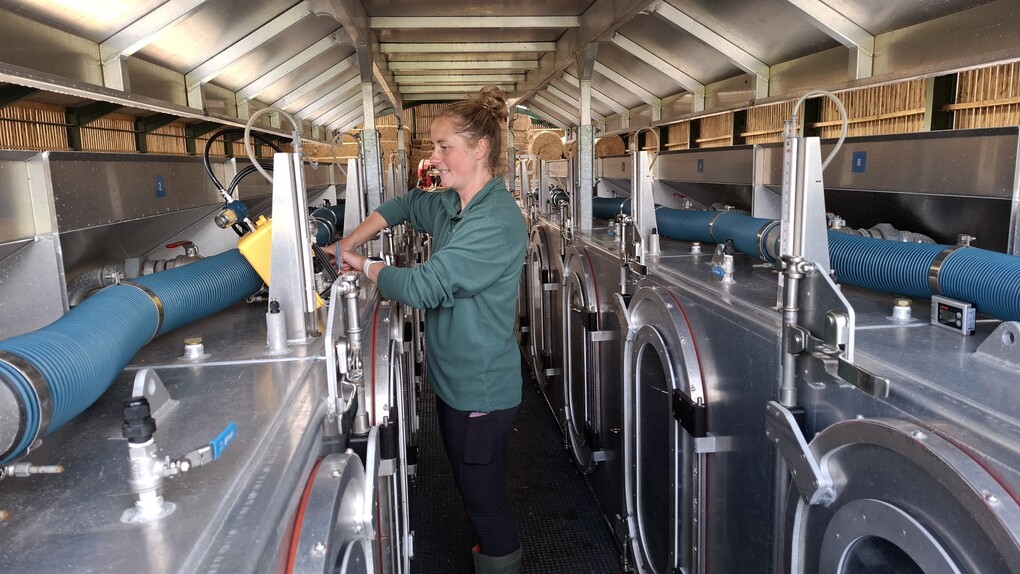
A range of studies from around the world have shown that some animals produce more methane relative to the amount they eat or the amount they produce. This variation is partly genetic, and it has been shown that we can select sheep to have lower emissions without any noticeable effects on their productivity – that is a gain we can bank right away through genetic selection.
Also, we expect that some sheep types are better adapted to particular forage environments, so we should look for differences in such adaptation – again, in terms of levels of production as well as methane per kilogram of meat, but also suitability to particular environments.
Sustainability isn’t just about productivity and methane intensity. Another likely source of variation in methane production is that some forages may lead to less methane being produced for the same amount of nutrients supplied to the sheep – so we should look at what forages help sheep produce well with less methane per kilogram of meat.
Forage for CH4nge is a farmer-led initiative to explore these questions. What we find from this project will influence future genetic improvement programmes for sheep, better characterise different sheep types, and help develop forage-type specifications for different sheep systems.
Find out more

The aim of the Farmer Scientist Network at the Yorkshire Agricultural Society is to work with the crop and livestock sectors to find new ways in which science and technology can find solutions and underpin innovation in agriculture.