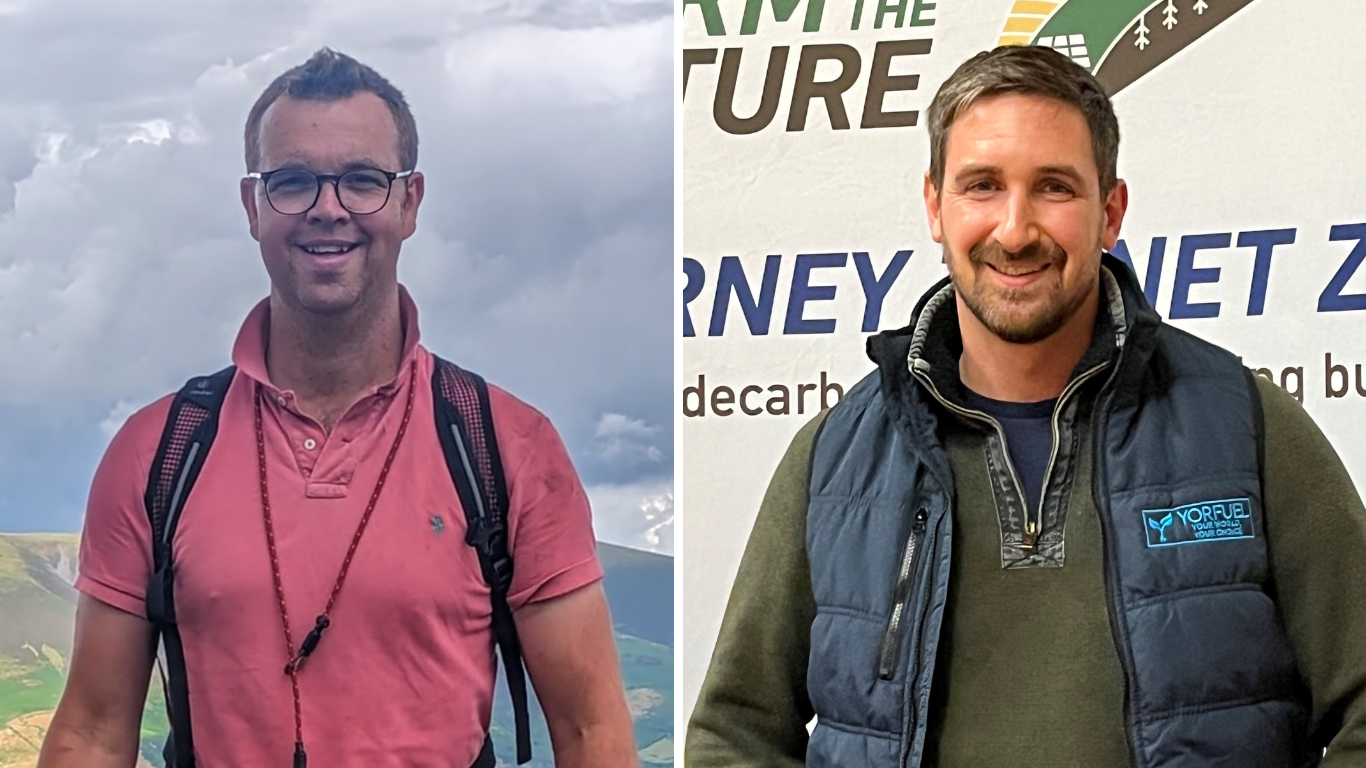
In our latest blog post, we share the reading that Future Farmers George Gill and Sam Dilcock delivered to the congregation at Ripon Cathedral’s Plough Sunday Service earlier this month.
George and Sam – two new members of the Future Farmers of Yorkshire Management Board – volunteered to take part and talk about the challenges and opportunities facing the farming industry at the service on 12th January which was supported by the Yorkshire Agricultural Society.
As we step into a new year, it’s an opportunity to reflect on the challenges and successes of the year gone by, while also looking ahead with anticipation to what 2025 may bring.
Farming in 2024 has been a year unlike any other, filled with numerous opportunities, but also marked by significant changes and threats to the industry.
If we consider the significance of the building we are in today, in its lifetime it has seen us go from one plough in each village to a time when some call to abandon the plough all together.
Perhaps the greatest success of the year gone by is the unity seen in recent months across the entire industry in response to political change and if the UK’s farmers can stand together, win the support of the public and politicians, perhaps positive change can be made sooner rather than later.
Farming’s unique role
As the UK strives to reduce its environmental footprint and move toward a greener future, I firmly believe that farming holds a unique role in achieving these goals.
Not only does agriculture play a vital part in ensuring we produce world-class, fresh food, but it is also essential in meeting our environmental objectives.
It is not a matter of choosing between food production and environmental care – these two priorities must go hand in hand.
By striking the right balance, farmers can continue to nourish an ever-growing population while safeguarding the health of our land for future generations.
An evolving industry
I’m sure many people here today see the call to balance food production and environmental care as good old fashioned husbandry.
Over the decades farming has become increasingly specialised in many parts of country.
Artificial inputs have allowed us to produce more than is truly sustainable from areas of land which are now showing signs of degradation.
We are however, also seeing more specialist businesses working together to deliver the skills and resources required to tip the balances in favour of more holistic approaches.
Shocks and shake ups
The agricultural sector has seen unprecedented change in recent years.
The end of the Basic Payment Scheme (BPS) has marked a turning point.
This scheme once helped farmers produce food at a more affordable rate, while ensuring that on-farm profits remained viable.
In its place, we now have the Sustainable Farming Incentive (SFI), which focuses on improving water quality, enhancing biodiversity, and mitigating climate change, all while supporting food production.
This shift is prompting significant changes in farming practices – from planting mixed crops and incorporating leguminous nitrogen-fixing crops alongside cereals to reduce fertilizer input, to changing field layouts by planting winter bird mixes or pollen and nectar flower mixes in less productive areas.
This is both a challenge and an opportunity for current and future farmers.
Whilst the opportunity exists to make investment into different working practises, it can be overwhelming to understand all the different options available to farm businesses under SFI and ELMS.
Much help is available from advisors and organisations such as the Yorkshire Agricultural Society to prepare for these changes and learn the skills required to implement them, another thing that should be celebrated in Yorkshire especially.
Spreading financial risk
While the financial support provided by the SFI is welcomed, it often falls short of replacing the benefits that BPS once provided.
As a result, many farming businesses are now having to find additional income streams to fill the gap.
Diversification has become a key strategy, with farms turning to new ventures like farm shops, cafés, caravan storage, campsites, or even converting traditional agricultural buildings into wedding venues.
These ventures help ease the pressure on the core farming business and ensure its sustainability in the face of changing financial landscapes.
This does mean however, that farmers need an even more diverse skill set to run their even more diverse businesses.
As if it isn’t enough been a worker, vet, engineer, plumber, builder, pilot, scientist, accountant, secretary, solicitor, carer, homekeeper, environmental steward and gosh know who else to make existing businesses work.
Navigating hospitality, retail, energy markets, new technology and marketing to make new ventures a success is indeed a daunting prospect.
Undoubtably though, necessity is the mother of invention and as we look around this region and this room, we find so many fantastic examples of how this can be achieved, and you must believe in yourself and persist in your endeavours to make your ambitions a reality.
A perennial challenge
Yet, one of the most persistent challenges for farmers remains the weather.
Last year’s harvest in particular, was disappointing.
Wet conditions during the drilling season in September and October 2023, followed by more than 10 months of continuous rainfall, led to wheat yields that were 32% below the five-year average in northern England.
Weather is something we can’t control, and its unpredictability continues to pose a serious challenge to our industry.
Take stock and make a plan
Adaptation is the precursor to evolution, and whilst we cannot control many of the variables that dictate the success or failures of commodities year on year, it is time to take stock of what is in your control and use it to the best of your ability.
Finding flexible approaches, spreading risk, benchmarking your business and analysing the failures as well as the successes will help you keep moving forward in an ever changing world and be prepared and resilient for the challenges and opportunities that we will all face in the years to come.
As we enter 2025, it is crucial that future generations are equipped to play an active role in agriculture, ensuring long-term investments are made.
This will not only preserve our agricultural heritage but also expand and build upon vital knowledge, driving the industry’s growth and sustainability.
Role of Future Farmers
We are both Board members of Future Farmers of Yorkshire, a thriving network of farmers, vets and other industry professionals across Yorkshire and beyond.
Supported and funded by the Yorkshire Agricultural Society, Future Farmers is in a position to support the professional development of those already working in the industry and equip new generations with skills to succeed through a varied training programme, through knowledge exchange and networking events, and bursaries to attend major industry conferences.
By offering this support through changing times and helping those in farming to see the opportunities that lie within the challenges that we face, combined with wider efforts within this great industry to set a positive, forward-thinking agenda, we can, together, ensure that the next generation inherits a thriving, secure, and viable industry that they will be eager to join.

Future Farmers of Yorkshire was launched in 2010 to bring together like-minded farmers, vets and industry supporters.
Since then the group has been joined by over 1,000 forward-thinking members, eager to expand their knowledge and excel in their careers. We support them by providing a platform for debate and the sharing of ideas.
The group is funded and supported by the Yorkshire Agricultural Society and is open to everyone within the industry.
Members are from a range of sectors and enterprise sizes, with a mix of tenants, owner-occupiers, managers and employees.